Thursday, October 21, 2010

Day Two: The Stories of Scotland


A bunkhouse breakfast, a final round of photos, and we descended from the heights of Glencoe into morning fog. As we drove through the eerie white stuff that turns trees, rocks, even oncoming cars into shapeless shadow monsters, our photojournalist turned to the others: "Guys, we were very, very lucky yesterday."

Across the top of the bottom of the Highlands we drove, stopping in Killen for what turned out to be absolutely the worst coffee ever served in Scotland. Jordan approached me: "Would it be an ugly American thing to do if I asked her to make a fresh pot?" Okay, so maybe I overdid the cautions before we left....

Armed with somewhat better coffee thanks to Jordan, we sped on to the ancient Fortingall Yew Tree, arguably the oldest living thing in Europe (estimated between three and five thousand years). Pontius Pilate may have been born near this site, while his father was Governor of the "rude Albian tribes." The area also sports a Neolithic cairn, so it's been inhabited awhile. Unfortunately, the Yew Tree has fallen victim to souvenir hunters over the years, but you can see the stone stakes marking where its girth once reached 56 feet. The Forestry Commission has pieces of the tree in cloning process, so if the original doesn't survive, its spirit and daughter will live on.

One of the coolest things about Yew trees is their Phoenix-esque propensity to grow a hundred years or so, stagnate, and then, at 500 years, suddenly start to grow again. It's never too late...


Fortingall's church let students begin to understand the terrible toll the Great War and its follow-up took from the Scottish farmlands, as their finest crop marched away. Every town in Scotland, no matter how small, has a war memorial. Even the tiny village of New Gilston (pop 300) where Jack and I started married life had a plaque; most have pillars or stone crosses. Fortingall's is inside the church.


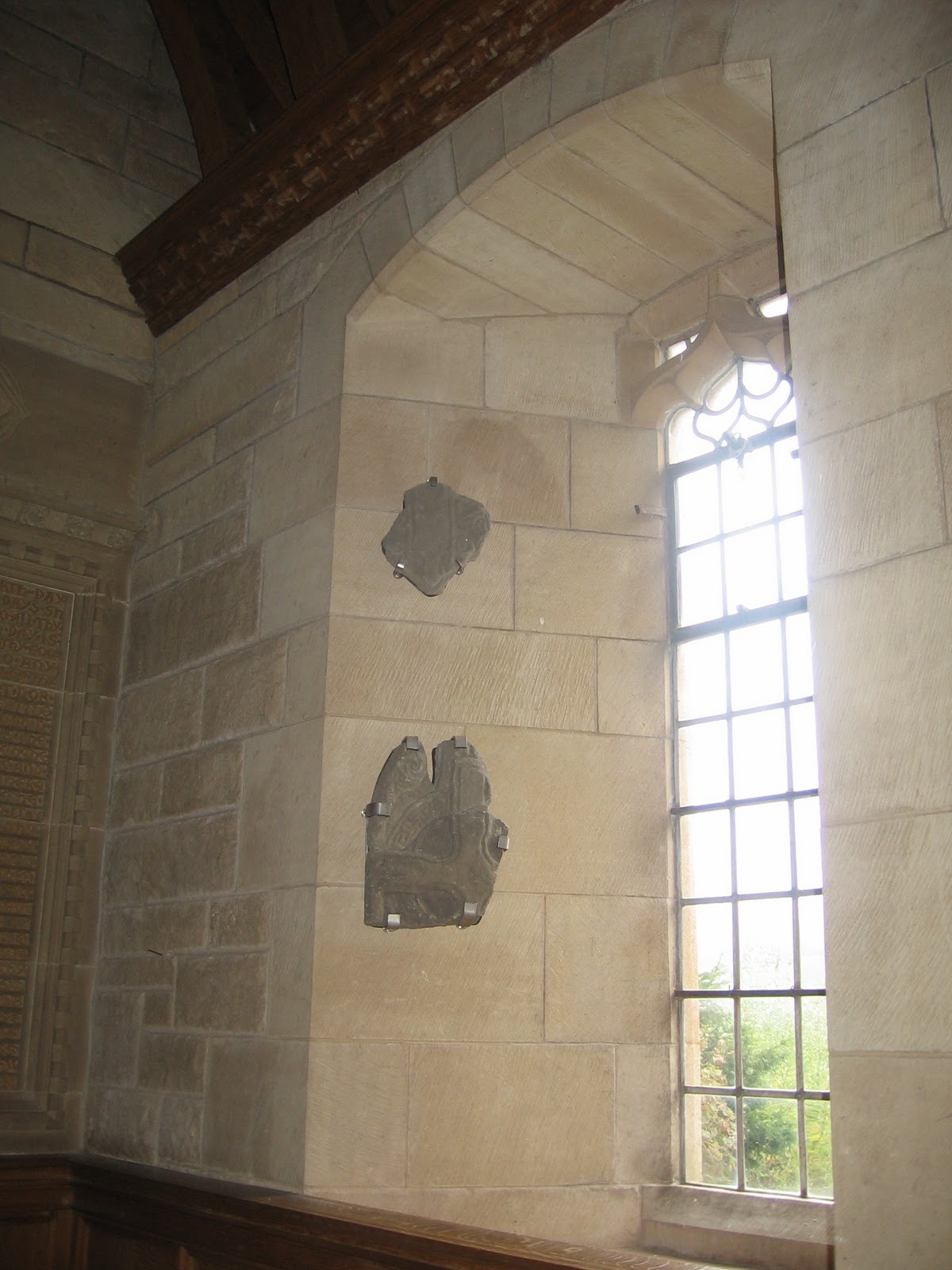


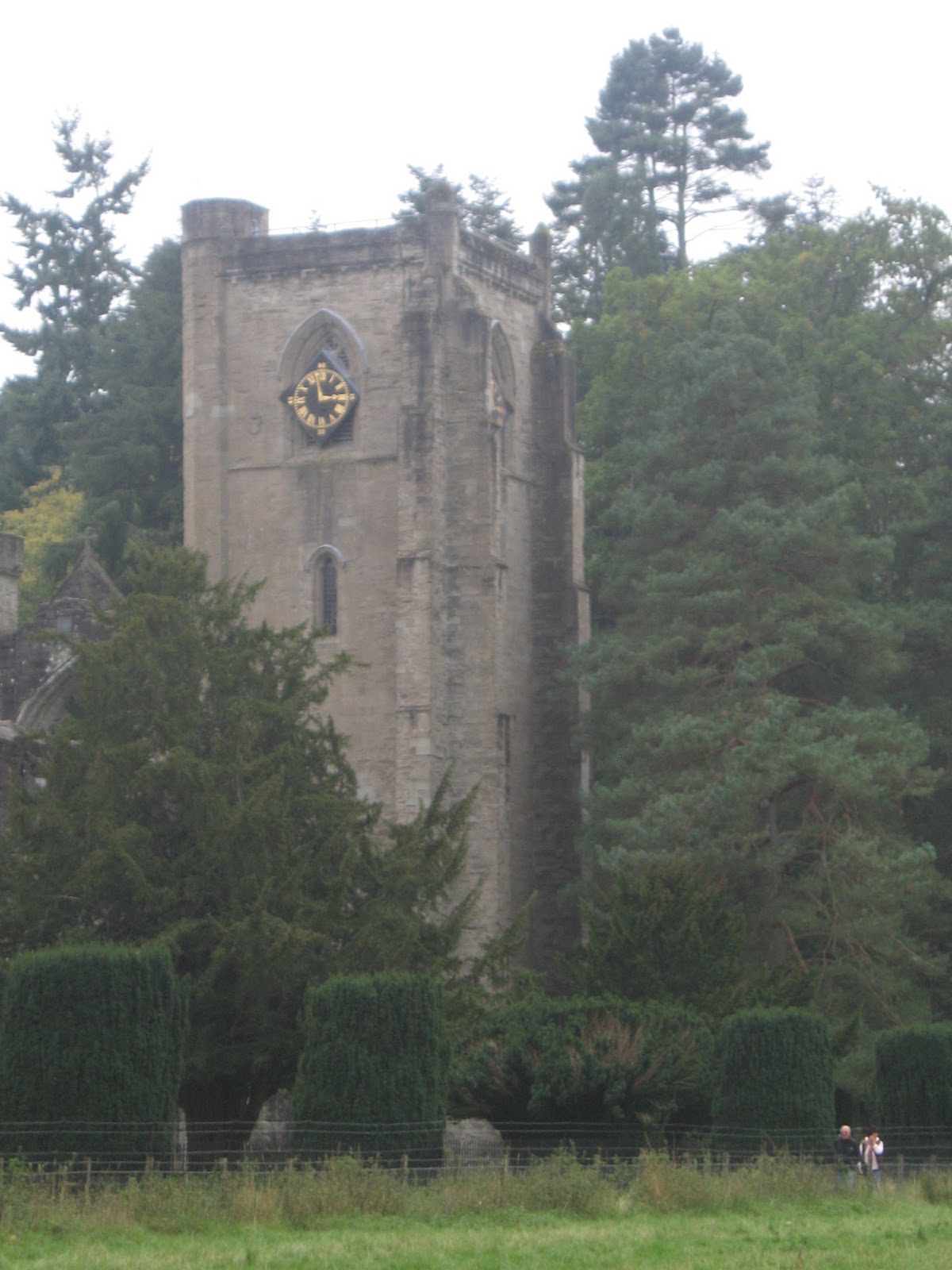
We stopped in Aberfeldy for pub lunches and in Dunkeld to see the medieval church and the sister tree to Fortingall's Yew, the Dunkeld Larch. This is the last of five trees brought as seeds from Tyrol in the early 1700s; most succumbed to wind and weather, or to the shipyard industry. The remaining larch stands at the back corner of the cathedral. (BTW, note in the picture of the crosses  below the different centuries their designs represent. It's unusual in Scotland to see them intact together. At left is the Cathedral's famous clock tour. Dunkeld is also one of many places where a ballad says Johnny dinged the dun deer doon.)

 
Never missing a chance, I pointed out the strategic connection  Dunkeld cathedral played between the McAlpine and Canmore dynasties in Scotland, and its tragedy in the Reformation (when the Other Side took the roof off to ensure its disuse, and burned some of the town.)  By then the students knew who Alexander and David were (you can find a list of Kings easily on the Net) so it was starting to come clear to them. But looking at the forest beyond, Jeremy was getting the most from it.

"That's the REAL Birnam Wood?" he asked, awe tinging his voice. "The one Shakespeare...?" Yep.
And our pre-dental student recited the famous Scottish Play passage for the rest of the group, who stood, silent, staring at the trees.

Back into the van and across to settle in the nicest hostel of the trip - Pitlochry Backpackers' hostel, right on the High street. I let them burn themselves out shopping before the next "lecture" of the evening: globalization and cultural tourism marketing.

That night we met at Macdonald's Family Restaurant, one of my favorite stories of Scotland defining itself. When THE McDonald's first came to Scotland, they sued this establishment for using a copyrighted name. Since the Macdonalds, who opened their place in 1959, reasonably felt that their family name should be their own, they went to court, where the judge agreed. There is no McDonald's restaurant in Pitlochry, although you find them many other places.There is, as there has been for more than half a century, a Macdonald's.
Of course students love stories of underdogs winning, but they loved their sticky toffee pudding even more.
Travis, MK and BrieSarah and Rachel


My favorite event was coming up that evening: a visit to Jock and Frances Duncan. Jock is one of the most venerated elder storytellers and ballad singers in Scotland, with good reason. His dry humor and easy manner combines with a way of telling historic stories as though he were talking about family members. He stops in the middle of verses to explain "'Cause, ye ken, she was plain folk an' he was a laird, so they servants in yon castle were ower mean tae her."

I had worried that my students might be too young or too American-underexposed-to-traditional-music to appreciate Jock. Nothing of it; they were entranced. He sang MacPherson's Lament (in honor of Sarah, whose family name traces back to them) and Laird of Drum and told several stories of his days working Clydesdales; Jock was one of the last bothy workers to plow with horses. He finished with the Four Marys. It was riveting.

And while the students got a thrill from Jock, he gave me an unexpected surprise. As a folklorist and a used bookstore owner, imagine the electricity that shot through me when he placed in my hands a 1925 copy of Gavin Greigg's "Last Leaves of Scotland." Colin, sitting across the room, started to hyperventilate. (If you're a folklorist and don't know about this book, look it up. It's incredible.)

  
Mary Katherine and Sarah with Frances. Sarah is holding an Irn Bru.
The mile walk to and from Jock's house was just enough exercise that Nutella had to be broken out before we slept. They're young and growing; they need to keep up their strength. And out they went to the pub to celebrate the legal drinking age with pear cider. (I was glad that they enjoyed being able to drink, but proud that they knew how to do it responsibly. No one ever had an irresponsible alcohol moment the whole time we were in Scotland.)

Brie photographing the Dunkeld Mercat Cross lions; the cross capella is its top.

Wednesday, October 20, 2010

Scotland Day One: Sticky Toffee Pudding Massacres


Awaking refreshed and rarin' tae get on wi' things, the students rolled out at 8:30 for the walk to Stirling Castle. Luggage quickly stowed - this was when we discovered Jeremy had brought eleven sweaters with him for eight days - we headed up the hill via the Old Town.

All I heard for the first minutes were cameras clicking. They photographed chimney pots, flower boxes, roundabouts, and any building with a crack in its walls. They photographed McDonald's and the nasty little pub. Life was a grand and glorious adventure.

I had forgotten, as an American who lived in Scotland the first six years of her marriage, how very amusing Scottish road signs can be to American sensibilities. Truth be told, I was rather proud of my students for the restraint they displayed. And reminded of the time, as an about-to-be-newlywed, that I visited a local wine merchant to order drink for the wedding. I'd been worried about returning unopened bottles. "Oh, don't you worry, dearie, we'll come fetch them," she said cheerily. "You don't want to be humping wine on your wedding day!"

Well, no....

We stopped off at the Church of the Holy Rude (yes, I know, but someone should have thought of it anyway) which sent them into further giggling fits. They spotted a great hill view in a parking lot and we took our first official group photo. And arrived at the castle promptly at 9, to discover it opened at 9:30. A sympathetic guard handed me a tourist map. "Beheading stone's that way," he said, tracing the route with his finger, then pointing down the road.

The students, winded from their uphill mile hike, perked right up. Off we went, gaily seeking the execution site of yore. Around the corner we met Alfred the basset hound, who was only too happy to greet us in the King's Name. The professor in me was tempted to explain the historic Alfred who might have actually had something to do with beheadings in Stirling, but they were having too much fun and the wee duggie was just too cute.

What must have been the last thistle blooming in Scotland adorned the hill--along with pizza boxes and empty cider bottles. Welcome to Stirling. Once everyone had the thistle safely stowed in their electronic memories, we headed up to the stone, a rather flat affair encased in graffiti.

One student asked, "Was anyone who was somebody executed here?" Regrettably, the communist Scot side of me flared momentarily. "Well, I'm sure their families thought so." Oh well. "No, William Wallace wasn't done here." The cameras stopped. It seemed like a good time to go back to the castle.

In the Great Hall, I chanced on Sarah and Rachel waiting to take each others' photos on the wooden thrones under the Lion Rampant. The lady just before us had an American accent--and a tiara! Her best friend had sent it with her for her trip to Scotland from Atlanta, to mark her fiftieth birthday. She loaned it to us and we each had our photos done as Queen for a Minute.
It was also at Stirling that I snapped one of my favorite pics: five tourists standing in the middle of a medieval castle courtyard steeped in history, talking on cell phones. Live in the bloody moment, why don't you??!! You can tell your friends about it later! Doubts about my Facebook dependencies began to niggle and wriggle in the back of my brain.

One other thing about Stirling Castle: it's always something between amusing and odd that the statue of Robert the Bruce turns permanently away from the Wallace Monument a few hills over, as if Bruce knows he has eternity to ponder how things might have been different.
 Amber, doing what she does best: exploring a new situation

Don't know who this guy is, but the sculptor did capture him in an unfortunate moment.... what's that saying, that you'll do something really stupid when the most people are watching? Hmmph.
 From the castle we headed down to load up the luggage - Jeremy began to regret his sweater plethora - and drive to Glencoe. For those of you who have been there, you will understand how truly unusual the photos that follow are. Glencoe was the site of a hideous massacre in 1692; if you want details, there are many sites on the Net only too happy to help you. For this blog, all you need to know is that Highland hospitality is at the root of Southern Hospitality, and until Glencoe was just as sacred. The munros (as they are known) are nothing to be toyed with in winter, and to refuse bed and board to a stranger in places with so few houses and so many dangers was tantamount to killing him yourself. Hence hospitality was sacrosanct, and between clans it was inviolate. So the killing of 38 people from the MacDonald settlement, including the clan father, his wife and at least three of their sons, by people sleeping in their houses was anathema. (Brie asked, "But why did they strip the chief's wife before they threw her into the snow?" Ah, sweet kids.)

With this massacre, all bets were off about cultural rules; you might as well carve up a baby for Christmas dinner. Explaining it to my students, I suggested that the Mullins came to church with the Bledsoes, and when the service was over, killed all the Bledsoes. It was the beginning of the breaking of a way of life. The Highland clan days were numbered--from 1692 to 1815, if you want to be precise.

So, partly because of the geography--valleys shadowed by mountain peaks that block the sun--and partly, perhaps, because of the horror perpetrated there, Glencoe is always dark and gloomy. Scottish weather is not known for the same hospitality as its people, but our drive into Glencoe was nothing short of glorious. Every single blade of grass stood out in the bright sunshine. The fall colors --October Blue sky, October Red grass--were brilliant. Cameras whirred and it took us an hour to drive five miles, as we pulled over for photos in every layby. Colin, a 65-year resident of Scotland, kept saying "I've never seen it like this. It's never like this."

But it was for the students, and they relished every moment of it. It wasn't until tomorrow, when the clouds descended, that they would understand how special God's smile on them was, but that day was nothing short of perfect.

Until, of course, we arrived at the hostel for the evening. We had booked a bunkhouse, and discovered it had unsealed windows that allowed birds to do unspeakable things to the pillows. From the glorious munros to the mundane mattresses--hey ho, the traveling life. I left my sorority girls staring numbly at the primitive bunks in the cinderblock room, and closed the door.

Five minutes later I went in to check on them, worried there might be tears. The door opened onto a carnival of color: towels hanging from rails, snapshots tucked into wall crevices, a radio playing, Nutella being passed round with shortbread for dipping, ladies in slippers briskly making up beds and singing along to an Ipod-esque thing on the windowsill. Women are born with coping genes. We are unstoppable.

They looked up, and smiled. "Everything okay in your room, Dr. Welch?" they asked. "Need anything?"

"Just a dose of humility," I muttered, slinking away to find one of my wine bottles.

After a scintillating lecture on Scots literature from Colin, they opted for pub supper rather than hamely faire, so we loaded into the van and drove to the Clachanhead, a backpackers' pub that sported a brass plaque: No Hawkers or Campbells allowed. The fact that they got it meant they'd been paying attention to my lecture on the Massacre. The fact that they didn't laugh paid tribute to their maturity and cultural awareness. Amber eyed the plaque, hands on hips: "Okay, it's meant to be funny, but it's still, like, mean, isn't it?"

I was beginning to really enjoy this group.

Fish and chips, steak and ale pie, and sticky toffee pudding were not only consumed, but photographed at just about every bite. The students moaned, squealed, exclaimed--and discovered that 18 was the legal drinking age in Scotland. Next, they discovered pear cider, and Mary Katherine's eyes rolled back in her head. Life as we knew it had just shifted into high gear.

Back to the bunkhouse we went, where I made my own discovery: several of the students, coming from Northern Virginia, had never seen a sky full of stars!. With no light pollution to speak of, I led those willing back outside and pointed out the constellations I learned as a young girl. Cassiopia. The Big Dipper (which they could just about find). Cygnus.

"Wouldn't it be cool if we saw a shooting star?" Rachel sighed, and one shot across the sky in a brilliant arc. The five of us outside stared, afraid to move. But we'd all seen it.

There wasn't anything that could get better about this day. We went to our bunks, thanking God for life and love and sticky toffee pudding.


Scotland: The Trip Out

The students were on time, a good sign. An October Blue sky, fluffy clouds, minimal luggage: even better signs. Everyone had confined themselves to an overhead wheelie case or a small backpack. Our group of nine--six women, two men, and me the erstwhile professor-in-charge (God help us all)--stowed luggage in the college mini-van and car, and drove off.

Into absolute silence.

Could these be post-teenagers, I wondered, as mile after silent mile ticked by. Excitement laced with nuances of fear tinged the atmosphere; perhaps the short word for that is anticipation. About 30 minutes into the drive, Amber spoke. (Amber would speak many useful firsts before the trip was over.)

"Well this is a nice quiet little ride!" she boomed. For a petite girl, Amber can fairly make herself heard.

That broke the ice. The group began discussing what they looked forward to: castles, food, European mannerisms, places they'd read about like Stirling and Dunkeld. William Wallace was mentioned reverently.

We stopped for fast food and I discovered a secret about herding post-teens: feed them when you want them lively. When we got back into the convoy, the chatter rivaled migrating birds. Movies, men, mammogram technology...I discovered most of my charges were science majors in the medical or environmental fields, although we did have a lone Education major, and two Undeclareds.

Knoxville Airport is charming, wooden carvings of whimsical bears decorating a central square fountain. The students lined up rocking chairs at the glass windows and watched planes taking off, eyes shining. With one exception--Brie, who would become our group photojournalist--none had been out of North America before.

waiting to depart Knoxville: Jeremy, Sarah, Jordan, Mary Katherine, Rachel     
The joy of travel lasted through Chicago. The girls congregated around the public toilets and watched, delighted, as Brie pushed the "change seat cover" button again and again. "That's adorable!" they cried. I knew then everything would be all right. How can the world go wrong when it has such nice kids in it?

At the food court, we snagged deep dish pizzas that sent them into ecstatic comas, and boarded at 8pm local time the eight-hour flight to London Heathrow. I had a lovely chat with the Belgian Orthopedic Surgeon sitting next to me. About an hour in, I heard shrieks, followed by loud laughter behind me, and a flight attendant raced past. I pulled my pillow over my ears and smiled at the surgeon, who taught adjunct at his own local university.

"Those are voices from my students," I said. "I will not look."

He patted my hand. "Sometimes that is the best way."
  Brie, Sarah and Travis succumb to excitement on the plane
At Heathrow the next morning we walked (halfway to Glasgow, or so it felt) until we arrived outside the airport. We stepped into the early morning light and I turned to my line of ducklings, blinking, bleary-eyed, in the smog.

"Okay, you're in London," I said, and their bodies erupted. They hurled themselves in the air, squealing "London, London; we're in London!" (Yes, it isn't strictly true; Heathrow is not in London per se, but give them their moment.)

As I stood to one side, watching, a black-suited traveler clutching a briefcase paused beside me, glaring. "Americans?" he barked. With a look of astonishment, I turned toward him. "How can you tell?" I asked in my best Scottish accent. He gave me a wary look and sped away.

Annoying American tourists 2, indigenous snobs 0.

Back into the bowels of steel, glass and escalators we descended, and flew to Glasgow without incident or sleep. There Colin the faithful bus driver-tour guide-literature professor met us, a Scotsman under his arm. (Yes, the old ones are the best.)

The 17-seater bus quickly became home as students claimed seats and tore into their luggage. Jeremy changed sweaters (there would be a lot of that to come); someone hauled out Gummi Bears. The party had begun.

Normally stopping for groceries is quite a chore, but on the way to Stirling we dropped into Sainsbury's and the students huddled near my cart, pointing and poking at things. Battenburg cakes were pronounced "charming"; the meat counter was frightening to those who had never seen streaky bacon; a shriek from the jam aisle announced the discovery of Nutella. (I used this moment to surreptitiously slip in two single-serving bottles of wine.) At the checkout, students poured over coins and bills, trying to make sense of them until, considerably heavier in the baggage department, we lumbered off to the Willy Wallace hostel.

It is the Law of Travel that anything with a cute name will be a dump. The students had never slept in hostels before, so the discovery that this room of 10 bunk beds would house all nine of us--professor included--gave some pause. It is heartening to watch newly-minted adults run smack up against a wall of new experience, and cope with dignity, grace and humor. Not a word was said as faces and luggage readjusted.

I set out a simple supper of Scotch eggs, the excellent Scottish cheddar, local tomatoes, oatcakes and chocolate. They fell on it all with gusto. I introduced them to teapots and by 7:45 we were fed, watered and Facebooked. (It was to become a running observation throughout the trip that no moment was completely lived until it had been e-translated for friends in the virtual world.)

Since we'd started at 11 a.m. Saturday, I pled age and settled in. The students went out. The first group was back at 8:20.

"Not a lot going on," they said, settling themselves on the couch to watch me use the computer. I can take a hint, and logged off as the next wave arrived back.


Stirling as night falls
Well, Stirling on a Sunday night has two things open: McDonald's, and the nasty little pub at the end of the High Street. By 9 pm we were all tucked up and snoring. Thus ended The Trip Out, and the first day(s). Tomorrow we would conquer Stirling Castle.